10 chest freezer organization tips: find it, use it, beat freezer burn
A chest freezer is a deep box where food goes to be forgotten. Bins by category, flat packages, dated labels and a running list turn it back into a store you shop from.

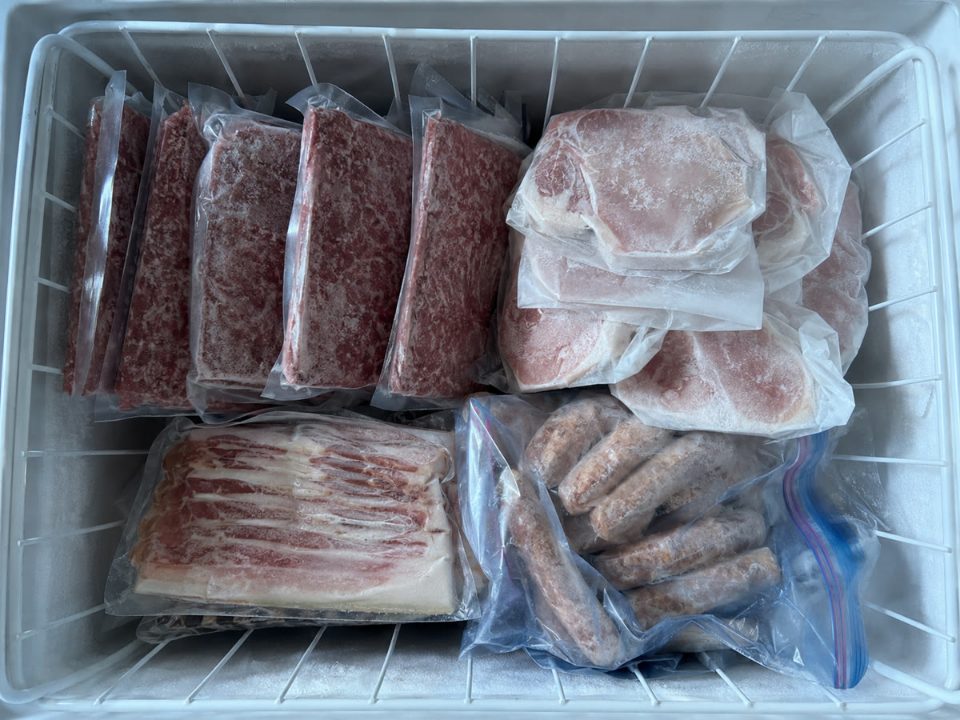
A chest freezer holds a lot, but everything ends up in one deep pile. The roast you bought on sale in March sinks under the ice cream and turns up in October, grey at the edges. The fix is structure: bins you can lift out, packages you can read from above, and a list that tells you what's in there before you open the lid. With holiday shopping starting and turkeys going on sale, now is a good time to set it up. The storage times and food-safety facts below come from university extension services, whose freezer charts are based on the USDA's.
Start with an empty freezer and a temperature check
Before you organize anything, take everything out into coolers and look at it. Toss what's unrecognisable or badly freezer-burned, and group the rest on the counter by type. Check the temperature while it's empty: North Dakota State University Extension says a freezer should be at 0°F (minus 18°C) or lower to keep food for extended periods. A cheap appliance thermometer left in the freezer will tell you whether the dial setting actually gets you there.
Divide the chest into lift-out bins by category
The bottom of a chest freezer is the problem, so stop treating it as a floor. Use sturdy, open-topped bins or baskets, one per category: beef, pork, poultry, fish, cooked meals, vegetables and fruit, bread and baked goods. Choose bins that fit the chest's width so two or three stack in a column, and give each bin a handle you can grab with gloves on. To reach the bottom layer you lift one bin out instead of digging. Many chest freezers come with a hanging basket on top: use it for whatever you reach for most, like the bread or the ice cream.
Freeze flat, then file packages on edge
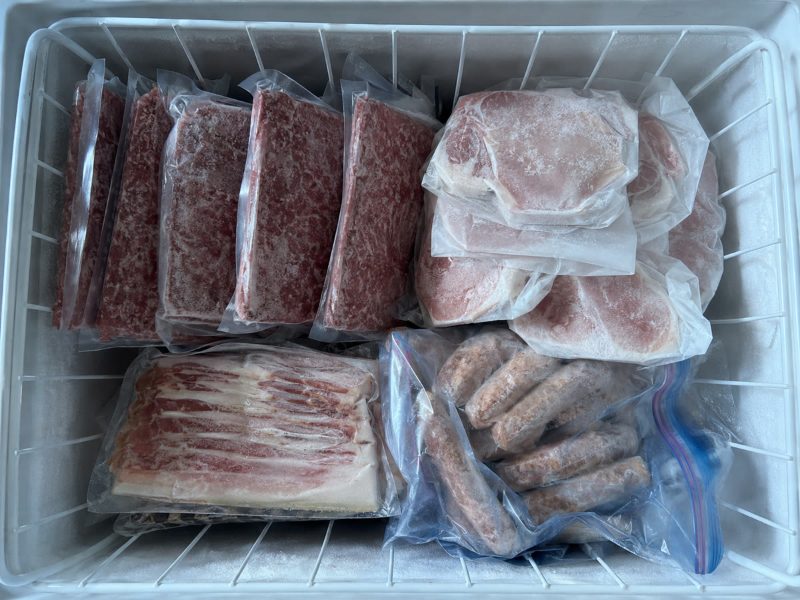
Flat packages freeze faster, stack neatly and thaw sooner. NDSU Extension recommends shallow containers because slow freezing makes large ice crystals that damage texture; food about 2 inches thick should freeze in about two hours. Press ground meat, soups and sauces flat in freezer bags and squeeze out as much air as you can, which Penn State Extension recommends to protect quality. Lay new packages in a single layer until they're frozen solid (NDSU says not to stack them before then), then stand them on edge in the bin like files in a drawer. You can read every label from above.
Wrap for the time it'll wait, because air causes freezer burn
Freezer burn is drying: NDSU describes it as greyish-brown, leathery spots where air has reached the surface of the food. It isn't a safety problem, but it ruins texture and flavour, and you can cut the affected parts away before or after cooking. Supermarket trays and plastic wrap are safe for freezing, but NDSU says they're only good for about a month. For longer storage, overwrap with heavy-duty foil, freezer paper or plastic wrap, or put the package inside a freezer bag. Split family packs into meal-sized portions in airtight freezer containers before they go in.
Label every package with what it is and the date it went in
“Beef?” on a frosted bag is not a label. Write the contents, the amount (“2 lb ground beef,” “chili, 4 servings”) and the date frozen on every package with a marker that works on cold plastic, or on freezer tape. NDSU Extension says to write the date you put food in the freezer on the package and arrange the freezer so the oldest packages get used first. Put the label on the edge that faces up when the package is filed.
Know the storage times, and what they mean
Food kept constantly at 0°F stays safe, but quality drops the longer it waits, according to NDSU Extension. The storage times below are for quality: past them, food is still safe but drier and blander. These are the University of Minnesota Extension's freezer times at 0°F:
| Food | Freezer time (quality) |
|---|---|
| Steaks, roasts, chops (beef, pork, lamb) | 4 to 12 months |
| Ground meat (hamburger, ground turkey, pork) | 3 to 4 months |
| Bacon | 1 month |
| Raw sausage | 1 to 2 months |
| Hot dogs, fully cooked whole ham | 1 to 2 months |
| Whole chicken or turkey | 1 year |
| Chicken or turkey parts | 9 months |
| Fresh fish and shellfish | 3 to 6 months |
| Cooked meat dishes, soups and stews | 2 to 3 months |
| Commercial frozen meals | 3 to 4 months |
Note bacon's single month: if you buy it in bulk, give it a spot near the top.
Keep a running inventory outside the freezer
The most useful freezer tool doesn't go in the freezer. Keep a list of what's in each bin somewhere you'll see it when you're writing a shopping list or planning dinner: a whiteboard on the lid, a sheet taped to the wall, or your phone. Cross things off as they come out and add them as they go in. It only works if updating it takes seconds, so keep it at bin level (“beef bin: 3 lb ground, 2 roasts, steaks”) rather than counting every package.
Plan the holiday bird and the bulk buys before they arrive
November sales fill freezers fast. Before you buy a second turkey or a case of butter, check the list and clear a bin's worth of space. A whole turkey keeps a year at 0°F for quality, so a sale bird can wait for spring. Plan the thaw, too: NDSU Extension says to allow at least 24 hours in the refrigerator for every 4 to 5 pounds, so a 20-pound turkey needs four to five days. Put a note on the calendar for the day it has to move to the fridge.
Thaw safely and know when you can refreeze
NDSU Extension lists three safe ways to thaw: in the refrigerator, in cold water (in a leak-proof bag, changing the water every 30 minutes and cooking right after) or in the microwave (cook immediately, because parts may start to cook). Don't thaw on the counter or in the sink at room temperature. Penn State Extension adds that meat thawed in the refrigerator can be refrozen within one to two days, though it may lose some quality. Meat can also be cooked straight from frozen; NDSU says to allow about one and a half times the usual cooking time.
Keep the lid shut in an outage, and defrost when the frost hits ¼ inch
If the power goes out, keep the lid closed. Washington State University's guidance is that a full freezer holds food for about 48 hours and a half-full one for about 24 hours, and that 50 pounds of dry ice keeps an 18-cubic-foot freezer frozen for about two days. When the power returns, discard perishable food that has no ice crystals left or is above 40°F. Those numbers are a reason to keep the freezer reasonably full.
Manual-defrost chest freezers build frost that eats space and makes bins stick. Whirlpool says to defrost when frost reaches about ¼ inch, and at least once a year. Unplug it, move food to coolers or wrap it in layers of newspaper under a blanket, open the drain, and let the frost melt with the lid open. Don't use a knife, ice pick or hair dryer. Defrosting is also the natural time to redo the inventory.
How StorageBuddy helps with your chest freezer
- Bins with addresses. Each freezer bin gets a short code, a photo and tags, inside a freezer location, so “which bin is the chicken in?” has an answer.
- The photo is the list. Snap an open bin and the AI itemizes it, outlining each package on the photo.
- Search from the store. Ask for an item or a tag like
poultryand see the bin, its freezer and its photo. Dates stay on the packages. - Shared with the household. Everyone who shops checks the same freezer from their own phone, and the export is free.
Free to start: your first 10 containers per space with unlimited items, QR labels, sharing, offline capture and full export. Plus and Lifetime lift the container cap. Nothing you catalog ever expires.
The chest freezer reset checklist
Print it, stick it on the bin, tick it off. One page.
- Empty the freezer, toss the unrecognisable, check it holds 0°F
- Set up lift-out bins by category, most-used items on top
- Freeze flat in a single layer, then file packages on edge
- Overwrap supermarket packs for anything kept over a month
- Label every package: contents, amount, date frozen
- Use oldest first; move bacon and ground meat along quickest
- Keep a bin-level inventory outside the freezer
- Clear space and plan the turkey thaw before holiday buying
- Thaw in the fridge, cold water or microwave, never the counter
- Keep the lid shut in outages; defrost at ¼ inch of frost
From “10 chest freezer organization tips: find it, use it, beat freezer burn” · https://storagebuddy-ai.com/blog/chest-freezer-organization · StorageBuddy AI
Questions people ask
How do you organize a chest freezer?
Empty it, then divide it into lift-out bins by category (beef, poultry, fish, meals, vegetables, bread). Freeze food flat, file packages on edge with labels up, put the most-used items in the top basket and keep a running inventory outside the freezer.
How long can meat stay in a chest freezer?
At a constant 0°F it stays safe indefinitely, but quality fades. University of Minnesota Extension gives 4 to 12 months for steaks and roasts, 3 to 4 months for ground meat, 1 month for bacon, 1 year for a whole turkey or chicken and 9 months for poultry parts.
Is freezer-burned food safe to eat?
Yes. Freezer burn is drying where air reached the food, so it's a quality problem, not a safety one. Cut the leathery, greyish-brown spots away. Heavily burned food may not be worth eating.
How long will a chest freezer keep food frozen without power?
Keep the lid closed. A full freezer holds food for about 48 hours, a half-full one about 24 hours. Afterwards, discard perishable food with no ice crystals left or that is above 40°F.
How often should you defrost a chest freezer?
When the frost is about ¼ inch thick, and at least once a year, per Whirlpool. Move food to coolers, unplug, drain, and let it melt with the lid open. Never chip ice with a knife or use a heater.
Sources & further reading
- NDSU Extension, Questions and answers about storing food in the freezer (FN1465): 0°F, shallow containers and fast freezing, freezer burn, overwrapping, dating, thawing methods and turkey thaw times, refreezing.
- University of Minnesota Extension, Storage times for food in the refrigerator and freezer: freezer storage times by food.
- Penn State Extension, Freezing and refreezing meat: removing air from bags, safe thawing, refreezing within one to two days.
- Washington State University CAHNRS News, Power outage: freezers: full and half-full freezer hold times, dry ice, when to discard.
- Whirlpool, How to defrost the freezer: defrost at ¼ inch of frost, steps and warnings.