10 garage organization tips that still work in March
Not a makeover, a set of rules. Zone by how often you reach for things, standardize the tote, respect the shelf's weight rating, and photograph every bin so you never open six to find one.
Most garage advice is a makeover: empty everything onto the driveway, buy a wall of cabinets, post the photo. Three months later the driveway pile has quietly re-formed inside. These ten tips are the opposite, small rules that change what happens after the weekend, when you come home with a new leaf blower and nowhere to put it. If you want the full five-part system (zones, vertical storage, numbered totes, seasonal rotation), it lives in our garage organization guide. This is the short list.
Zone by steps from the door, not by category
Everyone says “zone the garage,” and most people zone by type: sports here, garden there. Zone by frequency first. Count steps from the door you actually use. Zero to five steps is for things you touch weekly (recycling, the dog's leash, the good cooler, shoes). Five to fifteen is monthly (tools, bike pump, car wash kit). The far wall, the ceiling, the top shelves are for things you touch a few times a year. Then sort by category within each band. The daily band stays tidy because putting things back costs nothing; the yearly band stays tidy because nobody touches it.
Pick one tote and buy them all at once
Mismatched containers are why garages can't be reorganized. A rack sized for 27-gallon totes holds exactly a grid of 27-gallon totes; one liquor box and a wicker basket break the grid and the stack. Choose one size and one brand (lids and footprints differ between brands even at the same nominal gallons), buy enough for the yearly band in one trip, and keep two empty. When something new arrives, it has a tote shape to fit into instead of a floor to sit on.
Put the label on the short side, and make it readable from the car
Totes go on shelves short-side out, so a label on the long side is invisible the moment the bin is shelved. Label the short side at eye height on the tote, and put a second label on the lid for the stack on the floor. Write large: a code or a two-word name you can read from six feet away. Detailed contents lists on the outside go stale the first time someone adds a fondue set to the Christmas bin; keep the detail somewhere editable (a photo, an app, even a notebook) and let the tote carry only its name.
Heavy between knee and shoulder, and check the shelf's rating
Shelving fails from two directions: heavy totes at head height (dangerous) and heavy totes on the floor (never put back). Keep anything over about 30 pounds between knee and shoulder, light-but-bulky things up high, and nothing heavy above your head. Then read the rating on the rack. Manufacturers publish them: Gladiator's GearTrack wall channel, for example, is rated at 75 pounds per linear foot, and freestanding steel racks list a per-shelf limit that assumes an evenly distributed load. A tote of tile or paint cans can be 60 pounds on its own. Anchor tall units to the wall; the CPSC's Anchor It campaign covers the straps and the method.
Clear totes for things you hunt for, opaque for things you don't want to see
Clear totes are the default recommendation, but an entire wall of visible clutter is its own kind of noise. Use clear for the categories you actually search by eye (hardware, cables, sports odds and ends) and opaque for ugly bulk you only fetch by name (holiday lights, camping tarps, old towels). Either way, a photo of the open tote beats both, because it shows you what's inside without taking anything down.
Leave one shelf empty on purpose
A storage system with zero slack fails on the first purchase. When you finish the weekend, there should be an empty shelf (or at least two empty totes) with nothing assigned to it. It feels wasteful for a week and then it saves the system every month after that: the new sprinkler timer, the box the neighbour returned, the kid's sudden hockey phase. When the slack shelf fills up, that is the signal for a one-hour purge, not a sign that you need more shelves.
Hang anything with a handle; send the twice-a-year things to the ceiling
Rakes, shovels, ladders, extension cords, folding chairs and bikes all have a handle, a rung or a frame, which means they can hang. If it leans, it falls and gets moved; if it hangs, it's found. Wall rail systems and simple screw-in hooks on studs both work. The ceiling (overhead racks, or a platform above the garage door) is for the things you touch twice a year: holiday decor, the roof box, the camping bulk. The annoying spot earns the annoying frequency.
Know what the garage will ruin, and what's not allowed there
A garage swings from below freezing to well over 100°F and the humidity follows the weather. That rules out more than you'd think:
- Paint: Benjamin Moore recommends storing leftover paint between 60 and 80°F and never letting it freeze; a garage in a cold climate does both.
- Home-canned and pantry food: the National Center for Home Food Preservation advises 50 to 70°F and warns that dampness corrodes lids. Pet food in cardboard is a rodent invitation; airtight bins only.
- Electronics and batteries: heat permanently shortens battery life; Apple's storage range for its devices tops out at 113°F, which a sealed car or a sun-facing garage wall can exceed.
- Propane: cylinders larger than one pound are not permitted inside buildings, including attached and detached garages, under NFPA 58 as summarised by the Minnesota State Fire Marshal. Grill tanks live outside.
- Gasoline: many local fire codes cap gasoline in an attached garage at around 10 gallons in approved containers, and none in the basement. Check yours, and store cans away from the water heater and anything that sparks.
Put it back in ten minutes, and trade one in for one out
Two habits keep the weekend's work alive. First, a ten-minute reset at the end of any project: tools to the wall, offcuts to the bin, the car pulled in. Not a tidy, a reset. Second, one-in-one-out for anything that lives in a tote: a new pair of cleats means an old pair leaves; a new tarp means the shredded one goes. Keep a donate box in the five-step zone so “out” has somewhere to go that isn't the floor.
Photograph every tote before it goes up, and search before you buy
The ten-second habit that makes the rest work: before a lid closes, take a top-down photo of the inside. It's a contents list that can't go stale, it kills the “misc” bin problem, and six months later you check the photo instead of climbing the rack. Then use it: before you buy another can of WD-40, bungee cord or box of #8 screws, check what you already own. Duplicate hardware is most of what fills a garage.
How StorageBuddy helps with your garage
- Codes you can read from the car. Every tote gets an auto-generated short code (
G-RA-07) from its location, printed on a QR label you can scan with any phone camera, no app or login needed. - The photo does the typing. Snap an open bin and the AI drafts the item list; you confirm the chips and move on. Offline capture works in a garage with no signal; the AI catches up when you're back in range.
- Search from the store. “Do I already own this?” answered before you buy duplicate number four.
- Bins move, the record follows. Re-home a tote from the rack to the attic in two taps; the label and code stay the same and the move is logged with a date.
Free to start: your first 10 containers per space with unlimited items, QR labels, sharing, offline capture and full export. Plus and Lifetime lift the container cap. Nothing you catalog ever expires.
The weekend garage checklist
Print it, stick it on the bin, tick it off. One page.
- Zone by frequency: weekly within five steps of the door, yearly at the ceiling and far wall
- One tote size and brand for the yearly band, bought in one trip, two kept empty
- Labels on the short side at eye level and on the lid; readable from six feet
- Heavy totes between knee and shoulder; shelf ratings read and respected; tall units anchored
- Clear totes for things you hunt for, opaque for bulk you fetch by name
- One shelf (or two totes) left empty on purpose
- Everything with a handle hung; twice-a-year items overhead
- Paint, food, electronics, candles and paper moved indoors; propane and fuel limits checked
- Ten-minute reset after every project; donate box within five steps of the door
- Top-down photo of every tote before the lid closes; search before you buy
From “10 garage organization tips that still work in March” — https://storagebuddy-ai.com/blog/garage-organization-tips · StorageBuddy AI
Questions people ask
Where do I start when organizing a messy garage?
Start with the five-step zone by the door, not with the whole garage. Clear and set up just that band (recycling, shoes, the leash, the cooler), because that's what you touch daily and what re-clutters fastest. Then do one rack at a time on later weekends, pulling a “why do I own this?” pile as you go rather than decluttering everything first.
What should you not store in a garage?
Paint that might freeze, pantry or pet food in cardboard, photos and paper documents, electronics and batteries, candles, and anything the fire code keeps out of buildings: propane cylinders over one pound and more than a small quantity of gasoline. The garage is for durable things in sealed totes off the floor.
How do I organize a small garage?
Go up and over: wall rails for anything with a handle, a rack sized to one tote type, and the space above the garage door for the twice-a-year items. Keep the floor for wheels only, and keep an aisle you can walk with a tote in your arms.
How long does it take to organize a garage?
One focused weekend for a typical two-car garage if the shelving already exists, longer if you're installing it. The more useful number is the ten minutes at the end of every project that keeps it organized afterwards.
Clear or opaque storage bins for the garage?
Clear for categories you search by eye (hardware, cables, sports odds and ends), opaque for bulk you only fetch by name (holiday lights, tarps). A photo of the open bin, kept with its location, makes the choice matter less.
Sources & further reading
- Gladiator GearTrack channel rating (75 lb per linear foot), product specification.
- U.S. Consumer Product Safety Commission, Anchor It!: anchoring shelving and furniture to the wall.
- Benjamin Moore, Storing leftover paint: 60–80°F, don't let it freeze.
- National Center for Home Food Preservation, Storing home-canned foods: 50–70°F; dampness corrodes lids.
- Apple, Keeping your device within acceptable operating temperatures: storage range −4°F to 113°F.
- Minnesota State Fire Marshal, LP-gas inside buildings: cylinders over one pound not permitted indoors, including garages.
- Lehi City Fire Department, Home fuel storage limits: an example of local gasoline limits for attached garages.
Keep reading
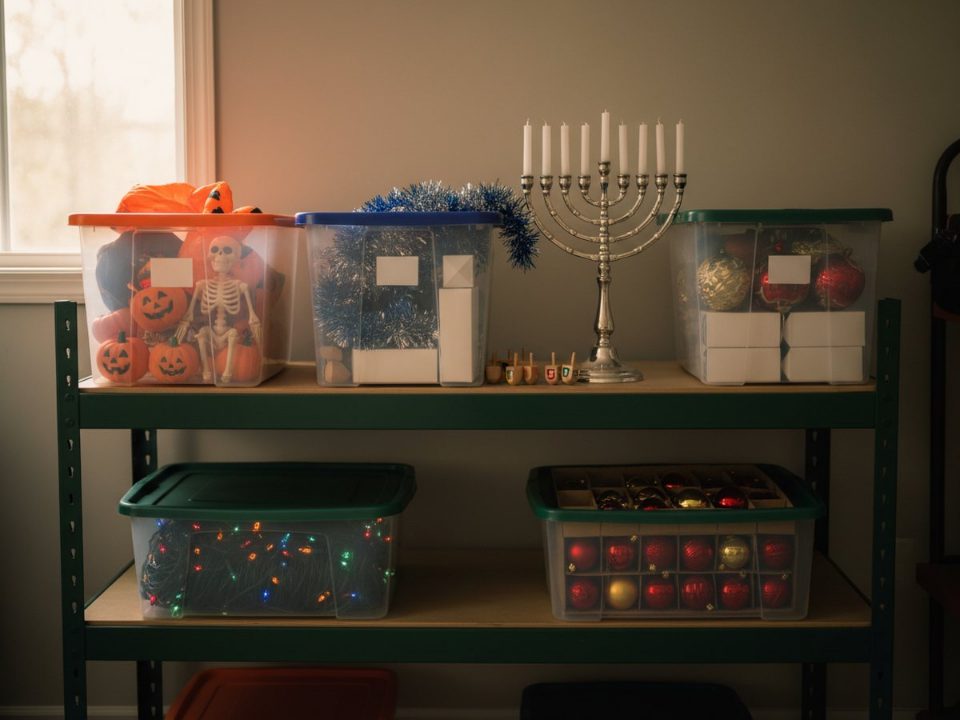
Holiday decoration storage: 10 tips for Halloween, Hanukkah, Christmas and more
October to January is one long storage season. Give every holiday its own tote and colour, pack powered props and inflatables the way their makers say, keep wax and latex out of the heat, and photograph each lid before it closes.
The garage organization system that actually sticks
Zones, vertical storage, numbered totes, seasonal rotation and the photograph-before-you-shelve habit.